> ## Documentation Index
> Fetch the complete documentation index at: https://docs.solidyne.ar/llms.txt
> Use this file to discover all available pages before exploring further.
# Audio Inputs
> Audio input description and wiring
## Line Inputs
The DX816/822 consoles feature various types of inputs, which are combined across the console's channels:
* **2 BAL-LINE**: Balanced inputs.
* **4 AUX LINE**: Unbalanced inputs.
* **2 RCA** on LINE channels, switchable from the front panel.
* **2 TRS minijack** on USB channels with **automatic switching**: when inserting a TRS plug, the USB audio is muted.
Unbalanced line inputs have a nominal level of **–10 dBV** into **10 KΩ**.
Gain adjustment is shared between both (main/auxiliary). Readjustment may be necessary depending on the connected equipment.
### Balanced Input Connections
The balanced inputs use shielded **RJ45** connectors and require shielded category 5 multipair cables. The preassembled cable kit **MNGDX822** is available, which includes all necessary cables for connection.
[Pinout diagrams and adapter cables for custom cabling](/es/DX816/816-conexiones-rj45).
***
## Microphone Inputs
The microphone inputs are electronically balanced and use standard **XLR connectors**.
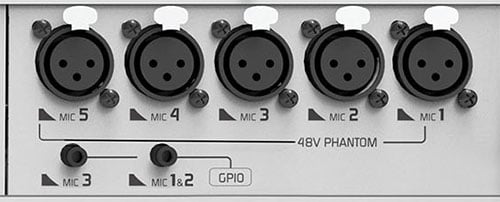 * 5 XLR inputs, labeled MIC 1 to MIC 5.
* MIC 4 shares preamp with MIC 2.
* MIC 5 shares preamp with MIC 3.
**CHANNELS**
Channel 1 ⟶ MIC-1 inputs\
Channel 2 ⟶ MIC-2 and MIC-4 inputs\
Channel 3 ⟶ MIC-3 and MIC-5 inputs
* 5 XLR inputs, labeled MIC 1 to MIC 5.
* MIC 4 shares preamp with MIC 2.
* MIC 5 shares preamp with MIC 3.
**CHANNELS**
Channel 1 ⟶ MIC-1 inputs\
Channel 2 ⟶ MIC-2 and MIC-4 inputs\
Channel 3 ⟶ MIC-3 and MIC-5 inputs
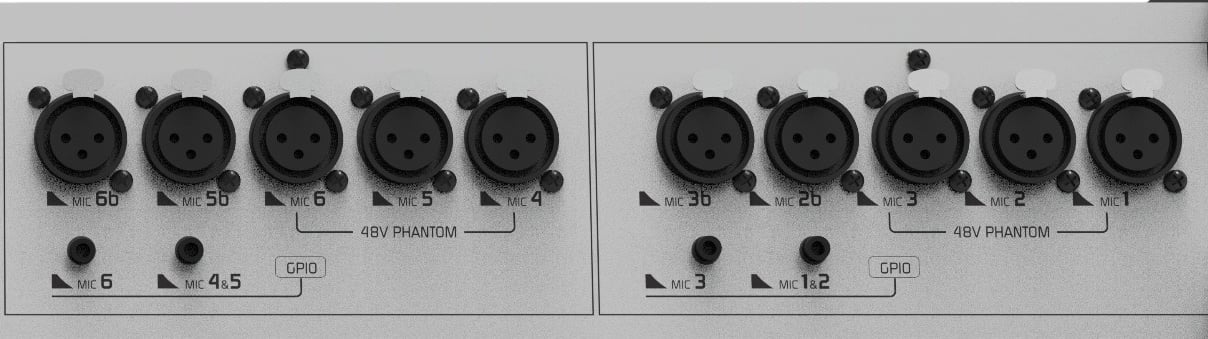 * 10 XLR inputs, labeled MIC 1, 2, 3, 2b, 3b, 4, 5, 6, 5b and 6b.
* MIC-2b shares preamp with MIC-2
* MIC-3b shares preamp with MIC-3
* MIC-5b shares preamp with MIC-5
* MIC-6b shares preamp with MIC-6
**CHANNELS**
Channel 1 ⟶ MIC-1 inputs\
Channel 2 ⟶ MIC-2 and MIC-2b inputs\
Channel 3 ⟶ MIC-3 and MIC-3b inputs\
Channel 4 ⟶ MIC-4 inputs\
Channel 5 ⟶ MIC-5 and MIC-5b inputs\
Channel 6 ⟶ MIC-6 and MIC-6b inputs
When using two microphones on the same channel, they must be of the **same make and model** to ensure signal uniformity.
***
### 48V Phantom Power
The **48V** button on the front panel activates floating phantom power for **all microphone inputs**.
In the **DX 822** model there is a second switch that toggles 48V for the second group of five inputs.
Dynamic microphones tolerate 48V phantom power, allowing mixing of dynamic and condenser microphones without risk.
* 10 XLR inputs, labeled MIC 1, 2, 3, 2b, 3b, 4, 5, 6, 5b and 6b.
* MIC-2b shares preamp with MIC-2
* MIC-3b shares preamp with MIC-3
* MIC-5b shares preamp with MIC-5
* MIC-6b shares preamp with MIC-6
**CHANNELS**
Channel 1 ⟶ MIC-1 inputs\
Channel 2 ⟶ MIC-2 and MIC-2b inputs\
Channel 3 ⟶ MIC-3 and MIC-3b inputs\
Channel 4 ⟶ MIC-4 inputs\
Channel 5 ⟶ MIC-5 and MIC-5b inputs\
Channel 6 ⟶ MIC-6 and MIC-6b inputs
When using two microphones on the same channel, they must be of the **same make and model** to ensure signal uniformity.
***
### 48V Phantom Power
The **48V** button on the front panel activates floating phantom power for **all microphone inputs**.
In the **DX 822** model there is a second switch that toggles 48V for the second group of five inputs.
Dynamic microphones tolerate 48V phantom power, allowing mixing of dynamic and condenser microphones without risk.