

Fundamentals
VQR (Voice Quality Restoration) processing was developed by Solidyne for its line of analog hybrids with landlines.Its purpose is to improve the audio quality of a phone call by reconstructing the spectrum lost during telephone transmission. Conventional lines (POTS) limit the bandwidth to approximately 300 Hz – 3,000 Hz, sufficient for intelligibility but eliminating low and high frequencies that contribute to a natural sound.
- The VQR system can reconstruct bass frequencies down to 50 Hz.
- It can also generate high-frequency components, restoring brightness and clarity to the voice.
- Although developed for landlines, VQR also improves calls made through mobile telephony.
For a detailed technical explanation, refer to the document: VQR System Theory
Using VQR Processing
VQR is activated by pressing its button to the ON position.The user controls the reconstruction using three knobs:
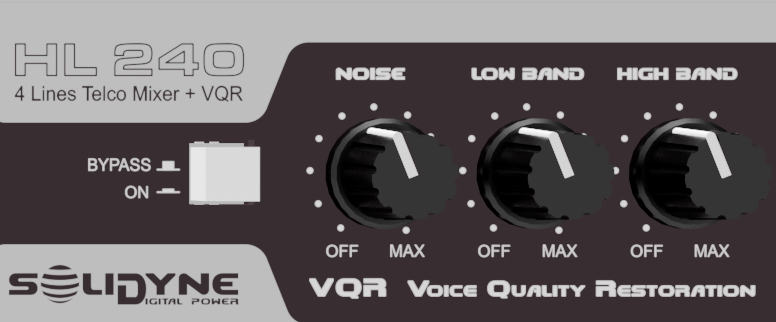
- LOW BAND (bass)
- HI BAND (treble)
- NOISE (noise reducer)
LOW BAND Control
Adjusts the amount of bass added to the signal.- To the left (OFF): no low-frequency reconstruction.
- Turning clockwise: low frequencies are enhanced.
Effectiveness depends on the original audio quality (phone used, send level from console, interference, etc.).
The worse the call quality, the less improvement VQR can provide.
The worse the call quality, the less improvement VQR can provide.
HI BAND Control
Adjusts the amount of treble added to the signal.- To the left: high-frequency processing disabled.
- Clockwise: progressive enhancement of high frequencies.
It’s important that the signal reaches the VQR stage with audio peaks hitting the red zone of the VU meter. If the level is too low or too high, reconstruction will be defective.
NOISE Control (noise reducer)
This control activates a noise gate (Expander-Gate).Its function is to attenuate background noise during conversation pauses.
- Knob to the left (OFF): gate disabled.
- Turning right: increases the threshold, i.e., the level below which the gate attenuates noise.
- If the noise floor is too high, it will always be above the threshold and the gate won’t work properly.
- If the noise is highly variable (example: street environment), it’s better not to use the gate to avoid a choppy background.
- If the noise is constant (hum or hiss), it may be preferable to leave it present, as the ear tends to mask it.
The operator’s judgment will determine when activating the gate is beneficial and when it’s better to maintain the ambient noise.