

Physical Channels
The UNIDEX UX24 console features 24 channels. The main unit has 12 physical channels with 100mm soft-touch faders. An additional 12 channels can be operated from the touchscreen or remotely via web. Optionally, up to two UX6 expansion modules (6 faders each) can be added to reach 18 or 24 physical channels.
- On physical channels, assignment to PGM, REC and AUX is done through three quick access buttons. When the channel is assigned, the button lights up orange.
- For all channels, VBUS assignment is done from the CHANNEL screen in the main menu or from web control.
2 CUE/SELECT BUTTON Serves three functions:
- CUE: Pre-fader listening. Allows monitoring the signal present in the channel before the fader and ON-AIR button.
- SELECT: Channel selection for settings and configuration.
- TALKBACK: TALK-BACK mode is used in communications (TELCO and USB channels assigned to call software). Holding CUE activates the talk-back microphone.
3 ON-AIR BUTTON Activates the channel.
When on, the signal is sent to the assigned buses according to the fader level.
4 OLED DISPLAY Shows:
- Pre-fader signal level. The CLIP indication shows that the input signal reaches 0 dBfs and requires gain reduction.
- Channel name or label.
-
Status in special modes like SELECT or TELCO.
About OLED brightness
Brightness reduces after 5 minutes of inactivity and turns off after 15 minutes.
Any control action reactivates the display.
5 MAIN FADER Controls signal level in the mix buses.
If the level is modified from the CHANNEL screen or remotely via web, the actual attenuation value may not match the physical fader position (non-motorized). In this case, the OLED display flashes showing the current value.
Moving the fader progressively synchronizes the value.
The SELECT Function
SELECT mode temporarily converts the CUE buttons into channel selection buttons.When active, CUE buttons light up blue and channel OLED displays show SELECT text. This function is used to choose a channel and view or adjust its settings.
The screen shows information for only one channel at a time.
For example, to adjust an equalizer, the operator must first select the corresponding channel to view its controls.
Activating SELECT Mode
SELECT mode activates in any of these situations:- Pressing CHANNEL on the main screen.
- Pressing PROCESS on the main screen.
- Pressing SELECT on the CHANNEL screen or a process screen (EQ, compressor, etc.).
- MODE A
Pressing a CUE/SELECT button displays the channel on screen. SELECT mode remains active, allowing selection of other channels (this enables easy channel comparison/review). The CUE/SELECT button of the currently selected channel keeps flashing. - MODE B
Turning the encoder to scroll through channels. The encoder scrolls through all 24 channels, whether physical or virtual.
”Virtual” Channels
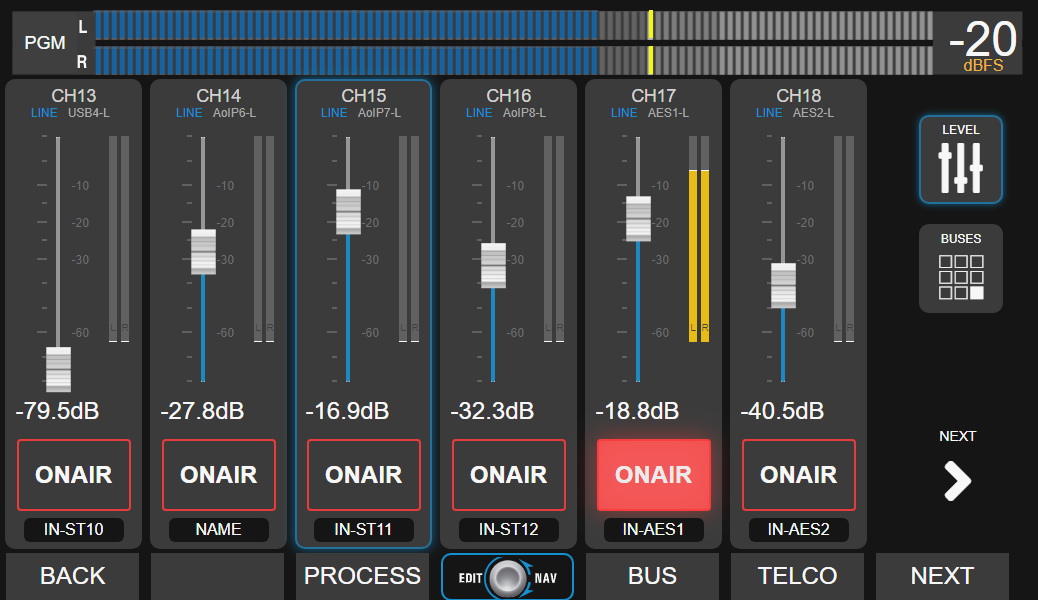
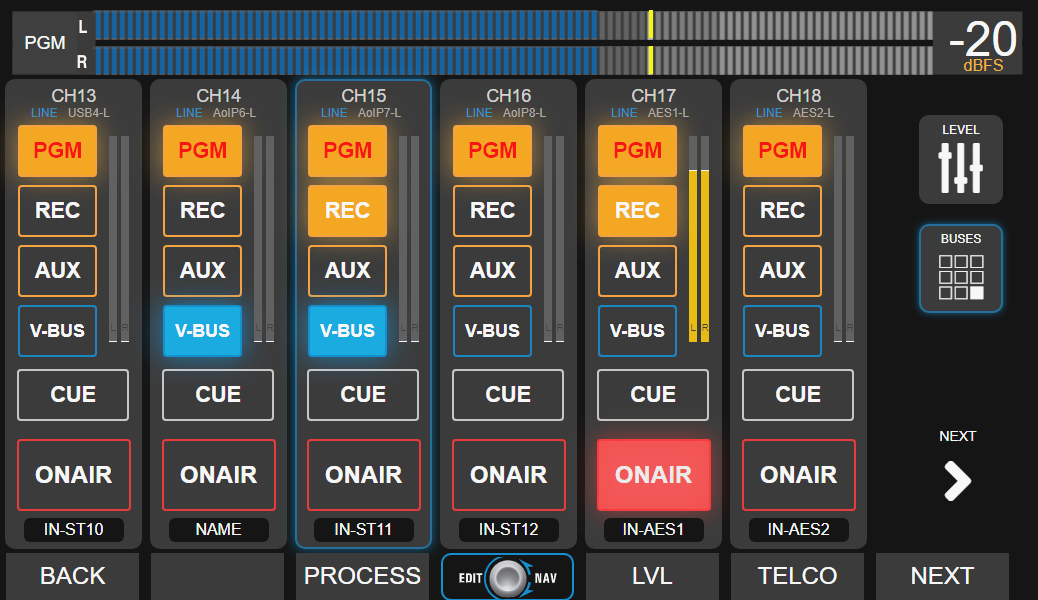
UNIDEX UX24 handles 12 channels from the onboard screen in its standard model, or 6 virtual channels when equipped with a UDX6 fader extension.The VIRTUAL MIXER screen allows control of all functions for these channels. When one or more virtual channels are on air, the VIRTUAL control (encoder) on the main screen flashes red to indicate this condition. To facilitate touch operation, virtual channel controls are divided into two screens. The LEVEL screen shows faders and ON AIR activation buttons.
Channel Screen (CHANNEL)
The channel screen shows all values and settings associated with a channel.It includes basic functions, like input gain adjustment, and advanced options requiring special permissions.
Accessing the Channel Screen
-
From the main screen, press the CHANNEL button.
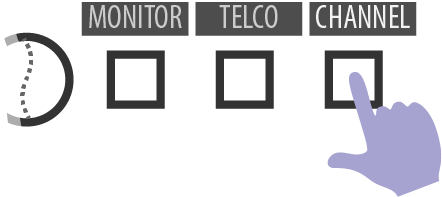
In the menu, the CHANNEL option changes to SELECT to allow enabling/disabling it. -
Select a channel:
With SELECT active, CUE/SELECT buttons allow choosing a channel. While selection mode is active, you can switch between different channels to compare their settings.- Virtual channels are selected by turning the encoder, which scrolls through all 24 channels.
- On screen, the channel name area shows in light blue for physical channels and purple for virtual channels.
-
Exit SELECT mode:
To confirm and exit, press the SELECT button on screen or press the encoder.
Selection mode also cancels automatically when modifying any parameter on the selected channel.
CHANNEL Screen Elements
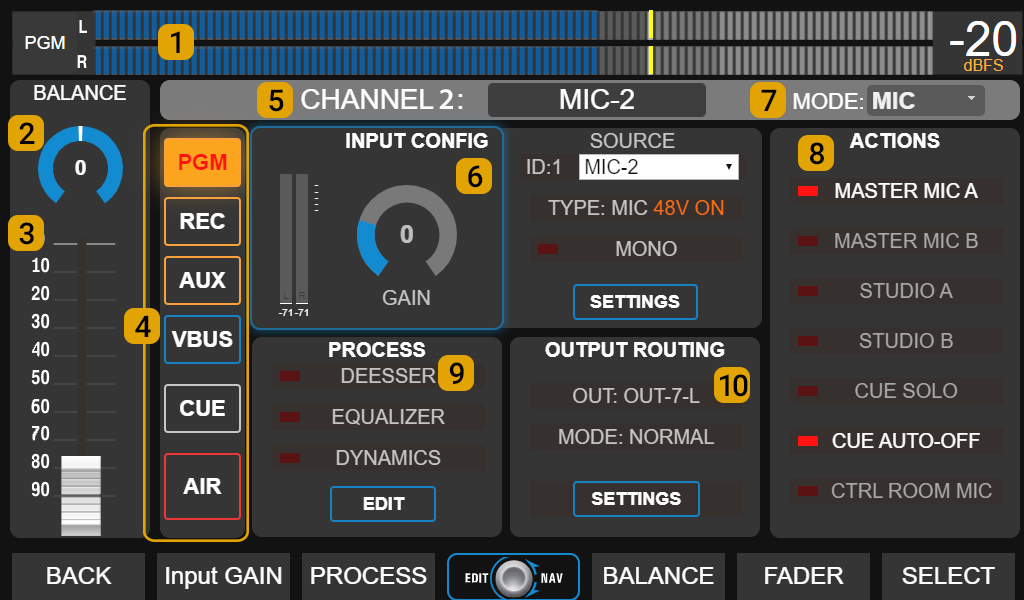
1 VU METER Level indicator visible on all screens.Shows the level of a mix bus, usually PROGRAM, in VU scale with peak hold.
- Touching the PGM label allows switching to show AUX, REC or VBUS.
- The number on the right indicates the maximum value, in VU or dBfs. Touching the number toggles between units. The VU/dBfs unit change applies to all screens.
2 BALANCE Adjusts left/right channel relationship for stereo inputs.
Acts as pan-pot for mono inputs.
To change the value, touch the control and turn the encoder. Press encoder to confirm.
3 CHANNEL LEVEL Represents the physical fader and modifies signal level in buses.
For channels with mechanical faders, the on-screen value reflects physical position. If level is modified from screen, actual value changes but physical fader doesn’t move (non-motorized). In this case, channel’s OLED display flashes current value to indicate it differs from physical fader position.
Output levels may differ from meter readings due to output gain compensation. Match occurs only when output is set to nominal level (4 dBu for analog outputs).
4 BUSES Show channel assignments to mix buses.
- On physical channels reflect PGM, REC and AUX buttons.
- On virtual channels allow assignment to any bus.
- Both allow assigning channel to VBUS, which has no hardware assignment button.
5 NAME Allows assigning up to 10 characters. On physical channels displays on channel’s OLED screen.
Touching the name opens a text editing window.
6 INPUT CONFIG Includes gain control and assigned input information.
- ADMIN profile: full configuration access by touching SETTINGS or reassignment from dropdown menu.
- Gain: adjustment in decibels via touchscreen and encoder.
7 MODE Defines channel behavior according to signal type:
- LINE: for any source other than microphones and communications.
- MIC: for microphone signals, whether onboard inputs, external UDX adapters or third-party preamps connected to line inputs.
- TELCO: for communications (landlines, VoIP, Bluetooth cellphones), controlling compatible UNIDEX adapters from TELCO screen.
8 CHANNEL ACTIONS Specific functions according to channel MODE.
- CUE SOLO: when activating CUE on channel, turns off CUE on other channels with this option active.
Channels without CUE SOLO active are unaffected, allowing CUE to be on in multiple channels simultaneously.
If all channels work in CUE SOLO mode, only one CUE will be on. A common configuration is using CUE SOLO mode on lines (computers and audio players) and normal mode on microphones and TELCO channels. - CUE AUTO OFF: automatically turns off CUE when channel goes on air.
- MASTER MIC A/B: assigns channel to one or both master buttons.
- STUDIO A/B: associates channel with “On Air” signaling (Tally Light) for Studio A, Studio B or none.
- CTRL ROOM MIC: If activated, putting channel on air mutes Control room speaker output (not Studio output).
9 PROCESS Shows available processors on assigned input and their status (active/inactive).
- On/off by touching name (except BASIC profile).
-
Settings editing from EDIT (ADMIN profile only).
Available processes aren’t channel-specific but depend on assigned inputs.
10 OUTPUT ROUTING Indicates if channel is associated with a direct output (e.g. UNIDEX adapters for TELCO lines).
Routing configuration is accessible in ADMIN profile from SETTINGS.