

Description
The console features two microphone channels.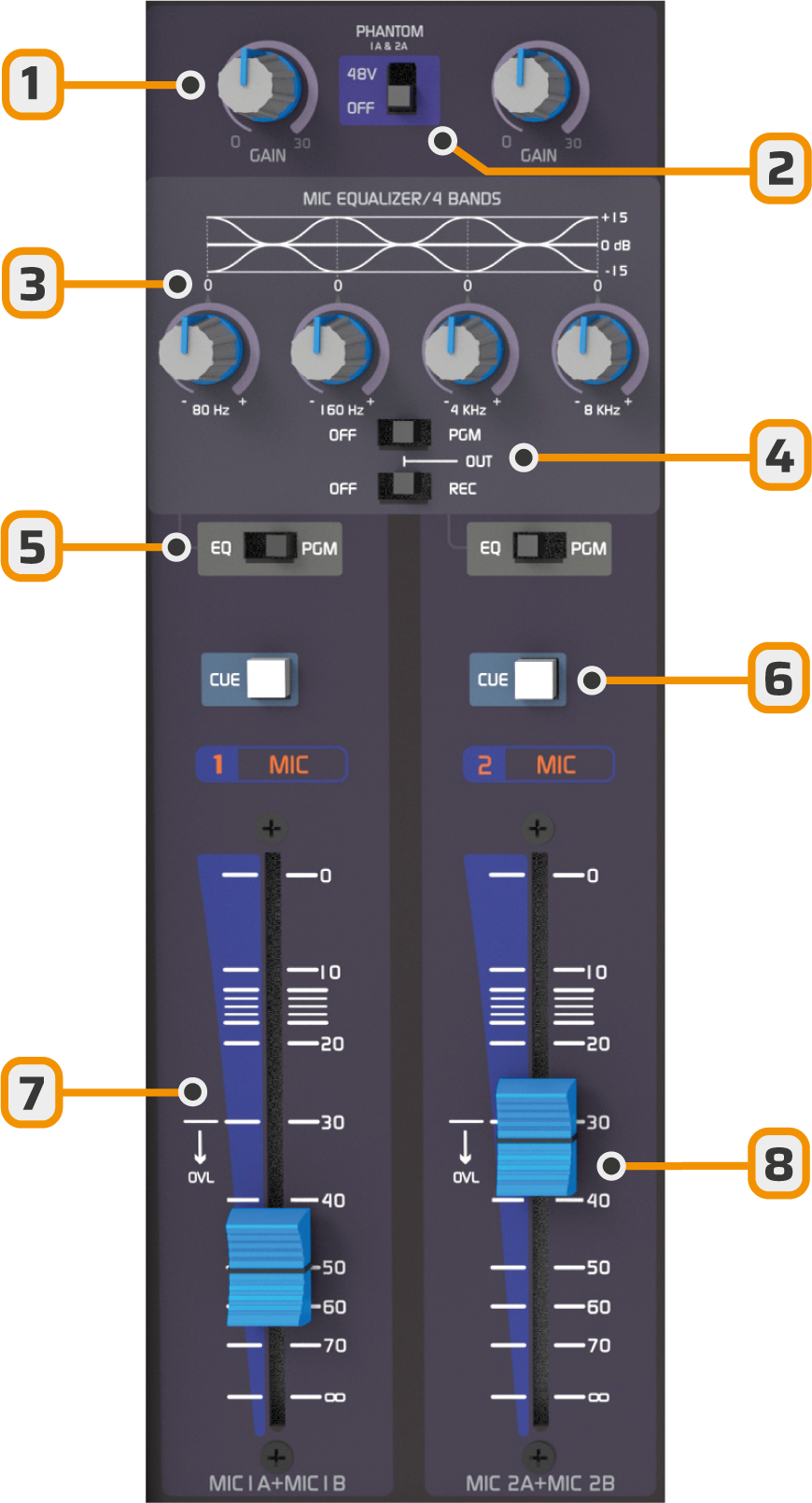
- Input gain adjustment.
- 48V phantom power: Activated for all microphones.
- EQ. Gain controls for frequency bands.
- EQ. Assignment of equalizer output to PGM and REC buses.
- BUS: Assigns the channel to PGM output or to the equalizer.
- CUE: Activates pre-fader listening ()
- OVL: indicates proper working range. If the fader is below this mark, it indicates excessive input gain.
- Fader: Main level control. Should operate in the zone marked between -20 and -10 dB.
Gain Adjustment
On microphone channels, depending on the speaker and distance to the microphone, it may be necessary to adjust the gain to work with the attenuator in the correct operating zone: above the OVL (-30 dB) overload indication.Assignment
Each channel can be:- Sent directly to air (PGM).
- Sent to the equalizer.
A channel cannot be sent directly to REC.
Equalization
The equalization is shared for both microphone channels.- The spectrum extremes work in Shelving mode, with a range of ±15 dB.
- The controls are specifically designed for human voice:
Compression
The compressor maintains constant voice peaks:- Acts whenever the microphone mix exceeds 0 VU.
- Below that level, the dynamic range remains intact.
- Has steep compression slope, with fast attack and release times.
- The action is shown on the main meter bridge:
- The MIC COMPRESSOR indicator shows the applied reduction in decibels.