

Input Channels
Microphones
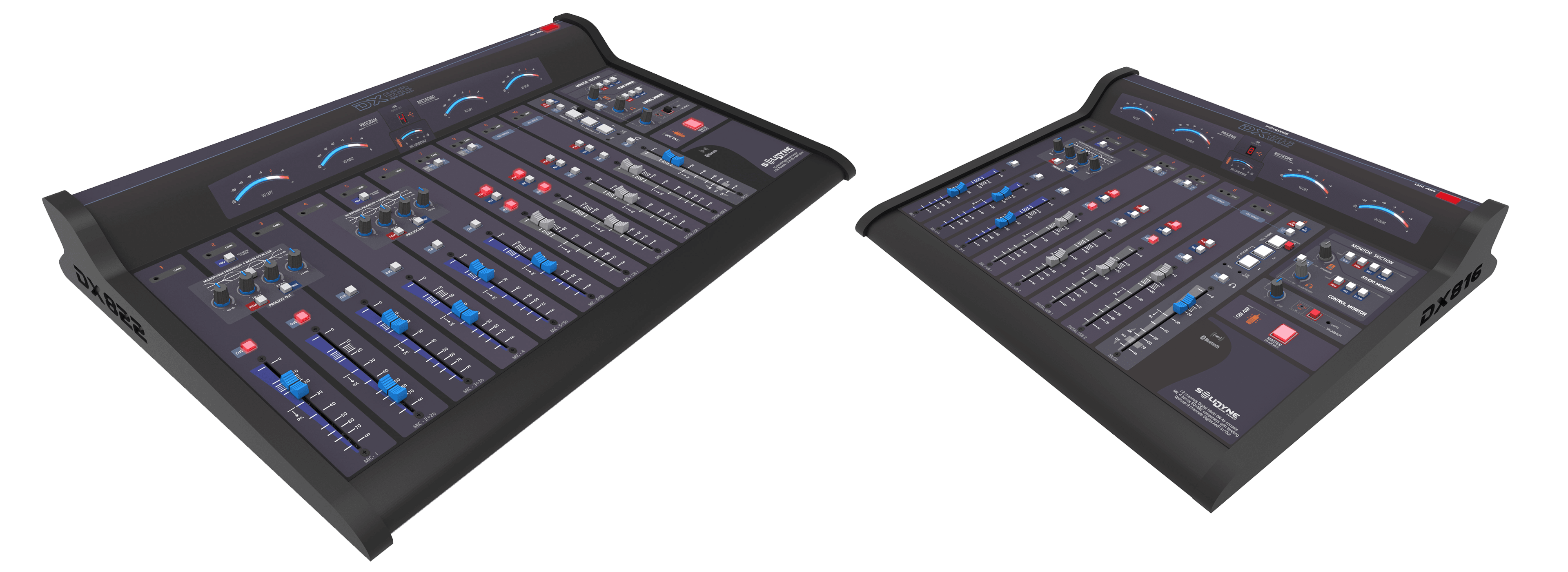
The Broadcast Classic line’s DX series includes the following models: DX816 and DX822.- DX816 features 5 microphone inputs. The use of dual preamplifiers and audio compressor allows handling 5 MIC channels from 3 faders. Channel 2 simultaneously manages MIC-2 and 2b inputs, while Channel 3 controls MIC-3 and 3b.
- DX822 provides 10 microphone inputs, distributed across 6 faders. The dual-input channels are MIC-2, MIC-3, MIC-5, and MIC-6.
Line Inputs
The four line input channels allow connecting up to 6 audio sources.- LIN-1 and LIN-2: switchable balanced/unbalanced stereo inputs, selectable from the front panel.
- Support signals from incoming Ethernet streaming on consoles with optional AoIP modules (DX816/AoIP and DX822/AoIP models).
Additionally, the console provides send and return connections for external hybrids. On models with the AoIP option, up to two Ethernet audio streams can be received, which are added to the PGM and REC mixes.
Summary of Available Inputs
Outputs
AnalogThe DX816/822 consoles offer two main outputs. The line, microphone, and telecommunications channels feature two assignable sends: PGM (program) and REC (recording). Digital
It includes two digital sends via USB, allowing direct connection to computers.
The operating system recognizes the DX816/822 interfaces as USB recording devices, transmitting the PGM (USB-1) and REC (USB-2) signals. Streaming (AoIP, optional)
With up to two AoIP expansion modules, the console can send PGM and REC as RTP streams over Ethernet, in addition to receiving up to two remote audio streams. This enables direct linking with transmission facilities, remote studios, or external journalists via the Internet. AES-3 (optional)
With an additional module, the console provides AES digital outputs for PGM and REC. It can be used in parallel with an AoIP module.
Output Summary
Monitoring
The monitoring section distributes signals to the studio and control room speakers and headphones. It includes:- Cue monitoring (CUE, PFL).
- Talkback to studio.
- Microphone master button.
GPIO
The DX816/822 allows triggering external devices when opening a fader, on the following channels:- MIC-1, MIC-2, MIC-3 (plus MIC-4, MIC-5 and MIC-6 in DX822).
- USB-1 and USB-2.
- Audio routing computers.
- Digital processors (e.g. Solidyne 462dsp, 562dsp, 542 APC).
- Specialized devices (e.g. Solidyne SmartCam video switcher).
Faders ETM-VCA
The DX816/822 consoles use conductive ceramic “touch of pen” faders, with a lifespan of over 20 years under normal conditions. Features:- Robust construction, movement on silver-steel bars with Teflon bushings.
- ETM-VCA (Electrometric Voltage Controlled Amplifier) control: audio signals do not pass through the faders, but through low-noise, highly stable amplifiers. The faders only send control signals.
- Completely eliminates noise caused by fader wear.
- Extends lifespan and eliminates maintenance.
- Outstanding stereo correlation (less than 0.1 dB error).
- Use of conductive ceramic faders with a guarantee of 10 million operations.