

FM Output – MPX
The FM OUTPUT menu configures the main transmission parameters:- Levels for stereo multiplex (MPX) signal outputs
- Basic RDS configuration
- ITU BS.412 power control
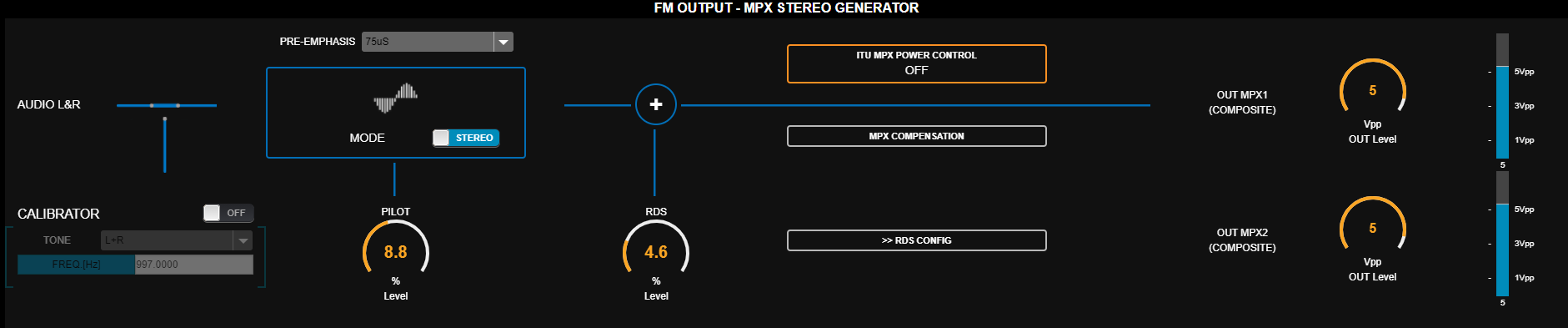
MPX Level
- Both MPX outputs have level control calibrated in Vpp (peak-to-peak volts).
- Level is typically adjusted to achieve 100% modulation at the transmitter.
- If the transmitter has MPX gain control, set the processor to 5 Vpp and make fine adjustments at the transmitter.
Pre-emphasis
Select the pre-emphasis curve according to your country’s standard:- 50 μs → Europe
- 75 μs → USA, Asia, Latin America
Pilot Tone and RDS Carrier
- PILOT: pilot tone level → 9% (factory default).
- Can be increased up to 12% in areas with high RF congestion.
- Higher pilot/RDS levels reduce audio loudness for a given modulation level.
- MODE: switches transmission between STEREO and MONO. In MONO mode, the pilot is suppressed and MPX signal is monaural. Switching can be done:
- Through configuration (fixed in system).
- Preset forced → Presets have a variable to switch to mono (see Preset Manager). In this case control will show “Forced to MONO by preset”.
- Remotely using 542 Lite Commander application (requires external computer and IP remote access).
- RDS: RDS subcarrier modulation → 4% (factory default).
MPX Output Compensation
- Pilot Phase: fine pilot phase adjustment. Improves stereo separation.
- SUB(L-R) adjust: adjusts L-R module level to compensate for coaxial/antenna system mismatches.
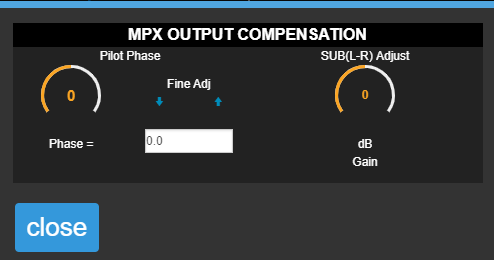
See Channel Separation Measurement and Adjustment
ITU BS.412 Power Control
Stage that regulates MPX signal power according to ITU-R BS.412 recommendation.Mainly applicable in Europe.
If your country’s regulations do not require BS.412, do not activate this control.
It will unnecessarily reduce on-air loudness.
It will unnecessarily reduce on-air loudness.
- Sets a limit on average MPX energy (60 sec window), maintaining maximum modulation at 75 kHz.
- Aims to reduce interference between stations with 100 kHz spacing.
- Reference standard: 0 dBr with +0.2 dB tolerance.
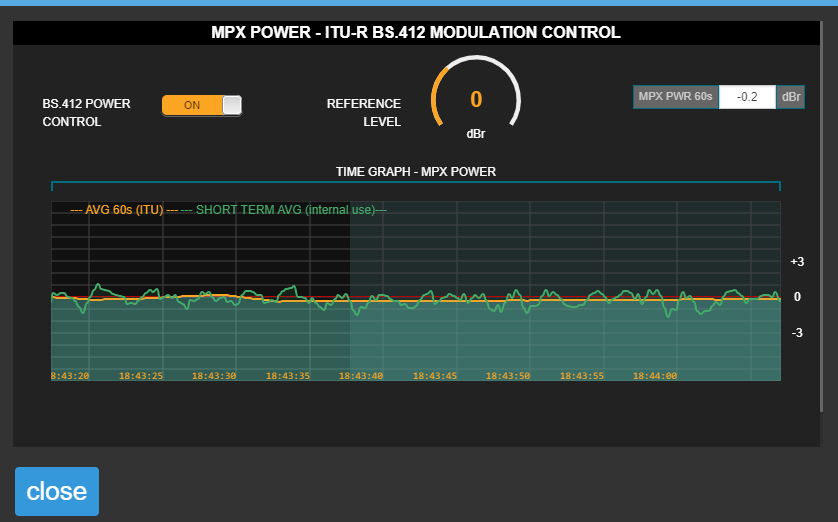
The time graph shows MPX power evolution over a 120-second window.
The graph presents a 60-second integration curve as established by BS.412; and a short-time integration profile. Processing Presets and BS.412 Any processing preset can be used with MPX power control active.
Factory presets include optimized adjustments for ITU BS.412 operation.
FM Modulation Adjustment
Factory default settings are 9% for pilot tone and 4% for RDS carrier.Usually these values don’t need modification. If changes are required, make them BEFORE adjusting modulation. Adjustment steps:
- Turn on the CALIBRATOR in the FM OUTPUT screen → a 400 Hz tone replaces the input signal.
-
Tune the transmission on the internal receiver and verify 100% modulation on the processor’s modulation indicator.
- Fine adjustment → modify MPX level (default: 5 Vpp).
The 542’s modulation indicator measures with fast integration of 125 uS (adjustable 0 to 1 ms).
Transmitters with slow meters may show different values with program material.
Due to slow integration, the transmitter’s indicator will be unable to show peaks. In this case, measurement will be more similar with higher program material peak density. - Turn off the CALIBRATOR → program signal returns to calibrated level.
About Modulation Peaks
- Many countries follow FCC (USA) standards → Recommendation 73.268.
- Slight overshoots are allowed on infrequent peaks (“In no case is it to exceed 100 % on peaks of frequent recurrence”)
- The 542APC complies with this standard, enabling this tolerance.
Stereo Separation Measurement and Adjustment
Channel separation can be affected by losses in the coaxial-antenna system. 1542APC includes pilot tone phase and (L-R) module gain adjustments that can partially compensate for transmission system non-linearity, improving channel separation.
(1) FM stereo separation degradation as a function of antena system VSWR,Adjustment procedure:
by Peter Onnigian, Jampro Antenna Company, for the 31st AES convention.
- On the FM Monitor Analyzer screen, measure channel separation.
Higher dB numbers indicate better separation.
If reading is above 40 dB (Excellent), no adjustments are needed.
Measurement introduces brief audible tones on-air.
Proper station tuning is essential for valid measurements.
Proper station tuning is essential for valid measurements.
- On FM OUTPUT screen open MPX COMPENSATION option
- Increase “SUB(L-R) Adjust” by 0.1 dB.
- Repeat channel separation measurement and verify if value improved over previous measurement.
- If separation increased → return to step 3, increasing again by 0.1 dB and repeating measurement.
- Continue until separation no longer improves.
- If separation decreases instead of improving, reduce SUB(L-R) Adjust by 0.2 dB.
- Measure separation again.
- Verify improvement.
- Repeat in 0.1 dB steps until best possible value is achieved.
- If Excellent value is still not reached, try adjusting Pilot Phase control in 0.5° steps, first one way then the other, to check for additional improvement.
- Once best possible value is achieved (with good transmitters and antennas should be Excellent >40 dB), save adjustment to internal memory by pressing SAVE in left menu.
- If not saved, adjustment is lost when processor restarts.
Values above 40 dB are not measured, as it’s proven that human hearing (even using headphones) cannot perceive improvements in stereo space sensation beyond this point.