

Dynamic Compression
Dynamic range reduction is achieved through three stages: compression, limiting, and clipping.These stages work together to decrease signal dynamics and increase average energy. Greater combined action results in a more “dense” and “compact” sound. Therefore, adjustments must be made holistically. In general terms:
- The compressor works with gentle slopes and low thresholds, reducing dynamics across a wide range of levels.
- The limiter acts with steep slopes and higher thresholds, applying significant gain reduction to keep the signal below threshold. Its action can be very noticeable.
- Attack times are typically slower in the compressor and very fast in the limiter. This preserves attacks below the limiter threshold, maintaining naturalness. Attacks exceeding it are attenuated by the limiter, depending on the DRIVE setting.
Multiband Compressor
The five working bands correspond to those defined in the multiband AGC. Each compressor is independent and has the following controls: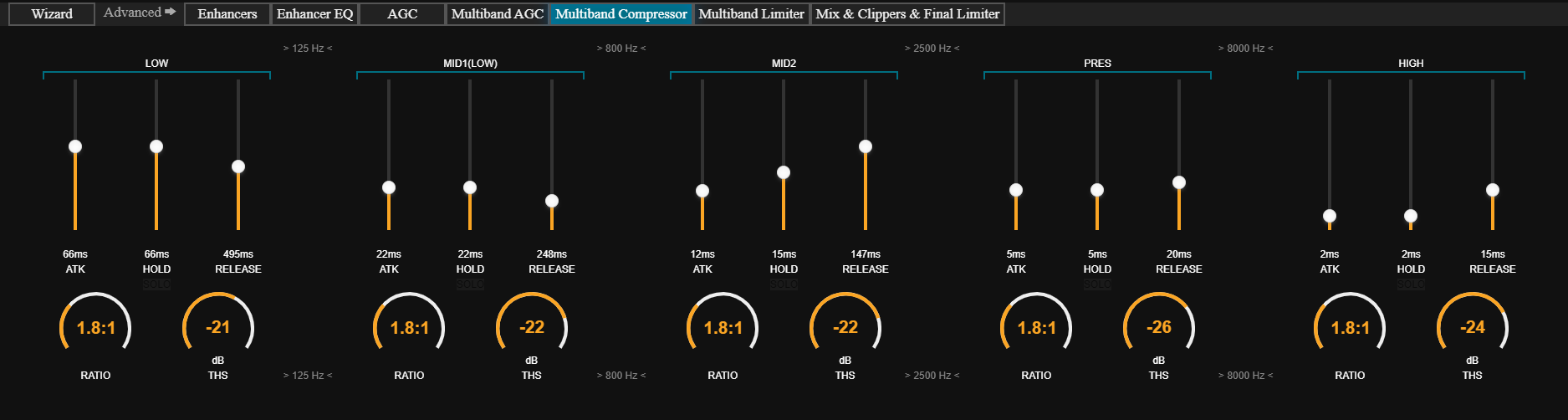
- Threshold (THS): level at which the compressor begins to act. Once reached, the attack time engages followed by attenuation according to the compression ratio.
- Ratio: defines attenuation applied from 1:1 to 10:1. Compressors use soft knee transition. As a rule, lower threshold means lower ratio; higher threshold means higher ratio. A low threshold with gentle compression affects more signals, which combined with limiting produces a more compact sound.
- Attack: time taken for the compressor to act after exceeding threshold. Longer times provide more impact but require more limiting and clipping. Adjustment depends on material:
- Rock/pop → slower times add impact and dynamic range sensation.
- Percussion → slow attacks in LOW and M1 bands for more punch.
- Orchestral/jazz/piano → fast attacks preserve naturalness.
- Release: time to recover unity gain when falling below threshold. Key for dynamic range sensation:
- Slow release → compressor acts continuously, like a leveler. Maintains dynamics but doesn’t generate large loudness increases.
- Fast release → enhances transients and attacks. Examples:
- Electronic music → short recovery in bass so each kick is affected by attack.
- High band → fast recovery increases presence and brightness but can harden sound.
- Hold: time compression is maintained once activated, regardless of input variation. Longer hold means less aggressive processing but also less loudness.
Multiband Limiter
Limiters apply a fixed ratio close to 100:1.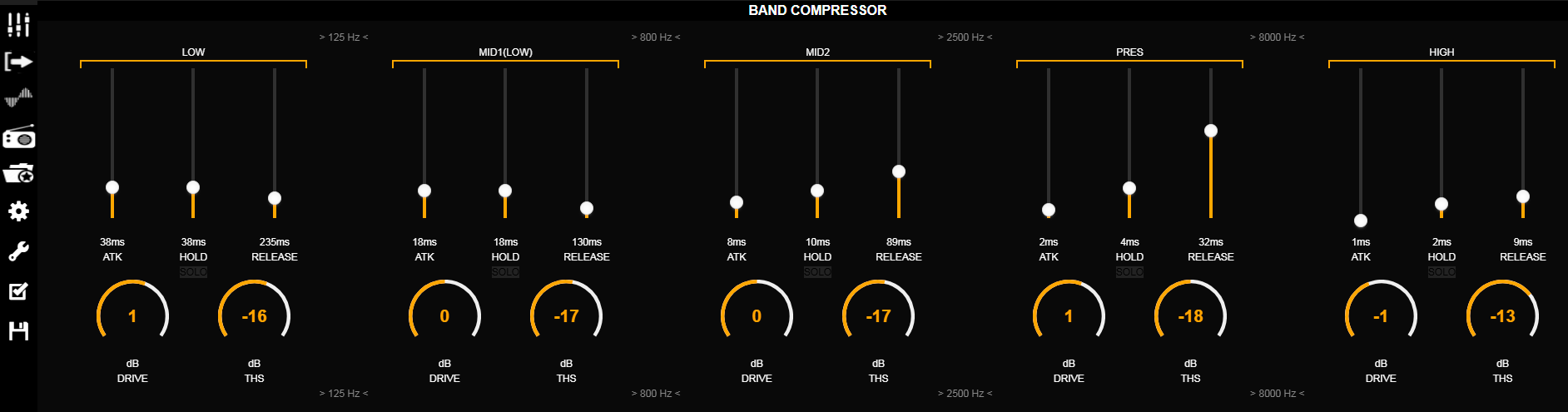
- Threshold (THS) and DRIVE:
- DRIVE applies gain before limiting. Equivalent to output level control in compressor. Increasing DRIVE while maintaining threshold means more peaks are limited and band energy increases.
- Lowering threshold increases limiting but reduces energy. This can be compensated by raising the band in Density EQ.
- Attack (ATK): during attack time, limiter allows peaks through that will be contained later by clippers. Fast attacks minimize clipping but sound becomes “flat” and unnatural.
- Hold and Release: function similarly to compressor controls.
Density EQ
The density equalizer allows adjustment of spectral balance, controlling how much each band contributes to the final mix.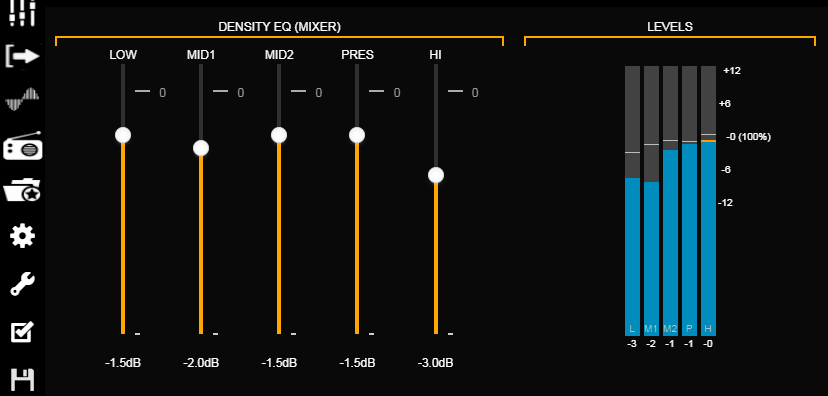
Clippers
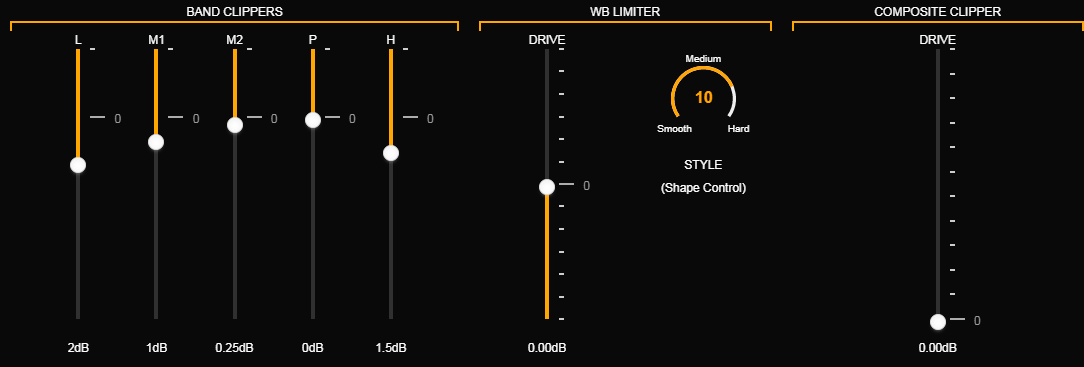
Band Clippers
Band limiters function as soft clippers, containing peaks that pass through compression due to attack times. The main control adjusts clipping threshold. The “0” reference equals 100% audio modulation.- Threshold below zero → that band will never reach 100% modulation alone, though band sum may.
- Threshold at zero or higher → doesn’t guarantee reaching 100%, depends on Density EQ level.
Above threshold, indicator shows limited signal in orange. In practice, band clippers are set at 100% or up to 1 dB below zero, except bass band, typically set 2-6 dB below to leave headroom in final sum.
Wideband Limiter (WB Limiter)
Band summing occurs after individual limiters. Even when set at 100%, summing generates peaks above this value. The wideband limiter contains these peaks, maintaining signal at 100%. This limiter “predicts” necessary attenuation using look-ahead (zero attack), avoiding harmonic distortion. Threshold is fixed at 100% modulation.- DRIVE control amplifies mix, increasing limiter action and total energy.
- SHAPE introduces soft clipping for working with higher limitations, minimizing intermodulation effects. This clipping only activates with high peak densities, remaining masked to the ear.
Wideband limiting increases loudness up to 6 dB reduction. Beyond this point, it offers no benefits and can create flat, depthless sound.
MPX Clipper
At chain end, sum (L+R) and difference (L-R) signals are separately soft-clipped. Threshold is at 100% modulation. DRIVE control applies gain before clipping:- DRIVE = 0 → clipping is practically null.
- DRIVE = 1 dB → means 1 dB of clipping.
- Values from 0.5 to 1 dB are tolerable in most cases.
- Higher values create harsher sound, sometimes identified as “FM style”.