

Wideband Automatic Gain Control (WB-AGC)
The Wideband AGC (WB-AGC) acts on the complete audio signal.Its function is to compensate for level differences at the processor input so the signal reaches subsequent stages with a constant and stable level. AGC timing settings are key and must be chosen based on the audio material. Settings designed for voice will require very different values than those designed for music.
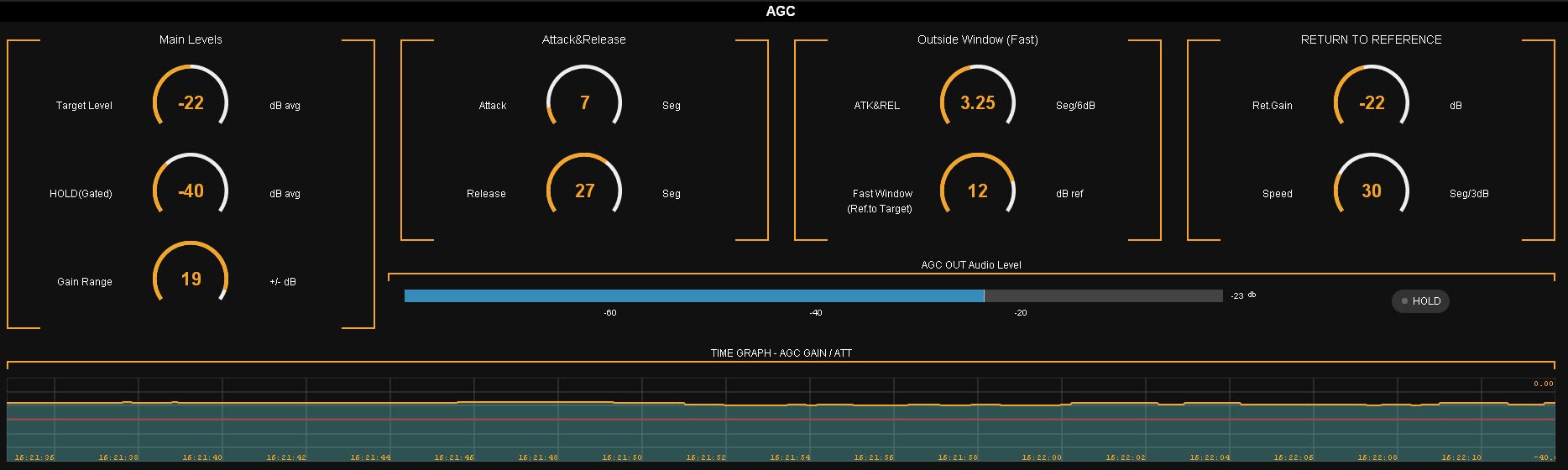
Target Level
The target level is the value to which the AGC adjusts the signal.When the input is below this value, it amplifies it, and when it’s higher, it attenuates it.
The AGC output always tends toward the target level, and this variation can be dynamically visualized in the AGC OUT time graph. The Gain Range determines the magnitude of possible attenuation or amplification. For example, if the range is 20 dB, the AGC can compensate for variations of up to 40 dB in the input signal.
If the hold threshold falls within the compensation range, the signal freezes and is not compensated.
Example:With hold at –40 dB, reference at –22 dB and a range of 20 dB, the AGC could compensate a signal of –44 dB. However, if the signal falls exactly to –44 dB, the AGC freezes and compensation only resumes when the signal exceeds the hold threshold
Hold
The WB-AGC is a gated type. This means that if the input signal drops suddenly, the AGC doesn’t immediately modify its gain, but instead freezes its current value.It remains in this state until the signal exceeds the hold threshold defined as “HOLD”. The value doesn’t remain frozen indefinitely. While the signal remains below the threshold, the AGC will slowly drift toward the reference level, with a slope established by the factory-set Return to Reference parameter. This mechanism is fundamental. Without it, during prolonged silence the AGC would try to compensate indefinitely and end up raising background noise to maximum.
The HOLD prevents this effect and also preserves the characteristic dynamic range of certain musical genres.
For example, if a soft instrument follows a loud passage, the AGC will maintain the previous frozen level, allowing that contrast to be heard instead of crushing it. [Content continues with technical translation following the same strict MDX formatting rules…]